
Given a rash of unsettling geopolitical and macro-economic machinations, the stock market mightbe expected to show signs of volatility and undo the recent positive streak of performance. War inIran and the Middle East, resultant higher oil prices and inflation, and rising interest rates did indeedtake some steam out of stock prices to begin 2026.
Market Summary
The last 3 months saw an extreme reversal of the weakness that was present in the US stock market to begin the year 2026. In fact, small stocks jumped to one of the strongest three-month periods in stock market history.
Large stocks of the S&P 500 Index sharply rebounded and rose 15.2% for the second quarter, and stood at +10.2% for the Year To Date. Small stocks represented by the Russell 2000 Index soared +21.6% and displayed a +22.7% return for the YTD. This was the fourth highest 3-month return for the Russell 2000, superseded only by Covid 2020 snapbacks, and 1999 during the Internet Bubble.
International markets that comprise the EAFE Index climbed +11.1% over the past three months and covered last quarter’s loss to stand at +9.9% thus far into 2026.
Aurora Perspective
In recent reports, we have highlighted Aurora’s GARP investment discipline, and our belief that long term investment results follow the earnings and growth of each individual company’s fundamentals.
In light of the head spinning spikes that have accompanied today’s stock market volatility, we are going to explore and explain some of the short-term, non-fundamental factors that can carry performance up and down in the short-term. Reading the recently published book “1929” by Andrew Ross Sorkin, conjures up commonality between historical downturns and crashes that are consistent over time.
In the corporate sector, prior periods of market volatility have been associated with infatuation over new technologies or “can’t miss themes” that captivate investors. The Nifty Fifty, automobile stocks in the 20’s, Internet stocks in the 90’s, and today’s AI stocks fit the description. It has been common in history to have large amounts of corporate borrowing to finance these capital intensive opportunities, and today’s circular financing for the AI build out is no exception. Today, Nvidia is the supplier, the customer and the financier to many of the same companies that are also suppliers and customers and vendors to still other AI hopefuls. Some of these companies have businesses that generate some cash flow, but most all have resorted to heavy borrowing to pursue AI future benefits.
Other common themes include rising levels of investor leverage/borrowing, investor emotion/psychology, speculative behavior and new products that promote combinations of these dynamics. The Momentum investment style (briefly defined as purchasing stocks that have gone up in price, assuming that will continue) is typically associated with FOMO investor behavior and often neglects any connection to business performance. In today’s marketplace, there has been a rise in new and non-regulated vehicles that are specifically designed to engage highly leveraged, speculative and short term motivated investors. SPAC’s, leveraged single stock ETF’s, prediction markets, and several other new on the scene offerings are all popular with younger participants, many of whom explicitly are involved in the markets for short-term opportunity, if not explicitly for gambling motives.
While we are among those anticipating AI’s prospects, there is another aspect of today’s stock market affection that gives us pause. There are several hardware companies that provide the wares to fuel AI’s buildout – from chip/memory companies to data warehouse construction companies to fiber optics manufacturers. These businesses surely have strong present demand for their products, and they enjoy high pricing power in the midst of the buildout race. But these cycles are predictably not long lasting, and typically work in reverse when the mania dies down. In today’s market, stocks like Corning, Micron Technology, and Western Digital (all stocks that blew both up and down in the early 2000’s) are up 200-300% and more in the last 12 months. These valuations can move just as quickly in reverse if there is a drop off in demand.
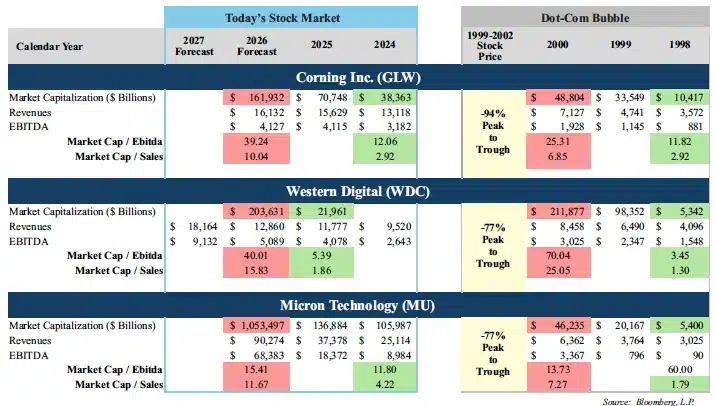
Adding to the risk of a reversal of the stock prices for these cyclical companies is that they have become a significant representative weighting in stock market indices such as the S&P 500.
Aurora Outlook
None of these observations indicate any imminent crash akin to 1929 or even 1999. But the similarity between the dynamics that sets the stage for such events exists. Aurora takes a long-term approach to reaching our clients’ investment goals. Within that mandate, we try and avoid the most speculative dynamics and believe our focus on individual and diversified company fundamentals is the best approach to mitigate risk and dampen volatility.
In the end, Aurora Investment Counsel has adhered to our fundamental based Growth At a Reasonable Price (GARP) discipline to deliver successful long-term returns with a balanced level of risk and volatility. Sometimes it feels out of step with certain market segments, but our focus and discipline have served clients well through many periods of ups/downs triggered by the “other” dynamics. We don’t see the need to alter our long-term focus, or to chase ephemeral trends like sentiment or supply/demand of IPO issuance.
Stock prices follow earnings over time – and the companies we have invested in historically and presently are delivering adequate reward and opportunity for our investors. Aurora is still finding the earnings, the cash flow and the growth that we need for appreciating stocks, and at attractive valuations that avoid the excesses of some overheated areas of the market.