Given a rash of unsettling geopolitical and macro-economic machinations, the stock market mightbe expected to show signs of volatility and undo the recent positive streak of performance. War inIran and the Middle East, resultant higher oil prices and inflation, and rising interest rates did indeedtake some steam out of stock prices to begin 2026.

Market Summary
After starting the year 2025 with negative performance, the following three calendar quarters saw appreciation and led to strong final results for stock market measures.
The S&P 500 Index, led primarily by large technology stock performance, rose 2.6% in the 4th quarter and turned in a very strong +17.8% final tally for the full year. Smaller stocks of the Russell 2000 Index likewise were lifted +2.2% in the last quarter, and had a +12.8% total return for the YTD.
Foreign stocks represented by the EAFE Index continued form, and after rising +4.9% over the last 3 months, have climbed an eye-popping +32.0% over 2025. It is worth noting that foreign stock markets began the year with much cheaper valuation measures (more on this later) than US stock measures, and also have been lagging behind the US stock market for some time prior.
While easy to forget, given the strong recovery at the end of last year, the market had negative performance for the first quarter. The S&P 500 declined -4% and the small stocks of the Russell 2000 dropped a heavier -9.5%. Noteworthy is that Aurora’s performance was slightly positive for the same period.
Last year, 2025, was not a great one for Aurora’s Growth At a Reasonable Price (GARP) investment process – at least compared to other benchmark indices. Our prior reports have noted some anomalies and certain market segments that received outsized attention and reward – namely AI-based businesses. While the stock prices of these companies appreciated on the hoped-for future revenues and earnings of nascient AI infrastructure, companies with current profits and revenue growth were largely left ignored. Aurora has not changed our methodology, and the companies we invested in largely delivered acceptable earnings progress (leading to the reported growth through the year). But relative to currently popular AI-themed stocks, the rewards were not shared equally between the two camps.
Aurora Outlook
Much of 2026’s forecasted earnings growth will be dependent on steadying conditions and the maintaining of high profit margins. This outcome will most likely rely on the benefits to come from higher productivity, which itself is reliant on artificial Intelligence applications and benefits. We are constantly vigilant over the ways progress is being made with this new technology, and are likewise monitoring the hurdles and impediments that arise. With literally trillions of dollars being invested (and borrowed) – the course of AI deployments holds risks not just for the high flying stocks of a few tech companies. Interest rates remaining on a downward trend, and general cost inputs staying benign will also be necessary to maintain the margins that will provide earnings growth. In summary, the US economy has several pillars pointing towards strong continued growth. While there are always crosscurrents, the environment seems supportive of continued earnings growth.
Aurora Perspective
Aurora’s Growth At a Reasonable Price (GARP) discipline is based on two important tenets:
- Stock prices follow earnings, especially over the long term.
- Stock price valuations are important risk indicators, and are helpful to avoid volatility.
As we enter 2026, the overall economic backdrop and general expectations across market sectors seems favorable.
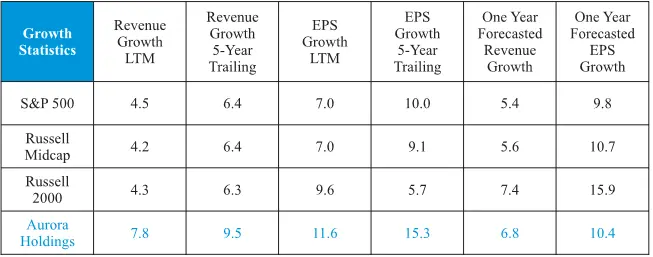
Average analyst expectations forecast Earnings Per Share Growth of 10% for the S&P 500 Index, along with Sales growth of over 5%. These are higher than historical levels of growth, yet seem achievable given current macroeconomic conditions. Remember that the growth in sales and earnings ahead of general inflation (estimated at 2.5% for 2026) is what generates the long-term appreciation from the stock market that we count on in client Investment Policy Statements.
Valuation and Risk Considerations
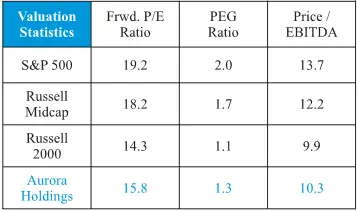
As longtime Aurora clients will recall, there is a second set of variables that influences the returns of stock market investors – namely valuations. While earnings growth is the fuel for future stock price appreciation- valuation tends to exert a braking dynamic when prices are too high for given EPS growth. We can also think of elevated valuations on stock prices as a risk indicator. It is here that the US stock market (large cap, tech stocks in particular) seem to be flashing warning signs, and where volatility can give way to negative periods in the short term.
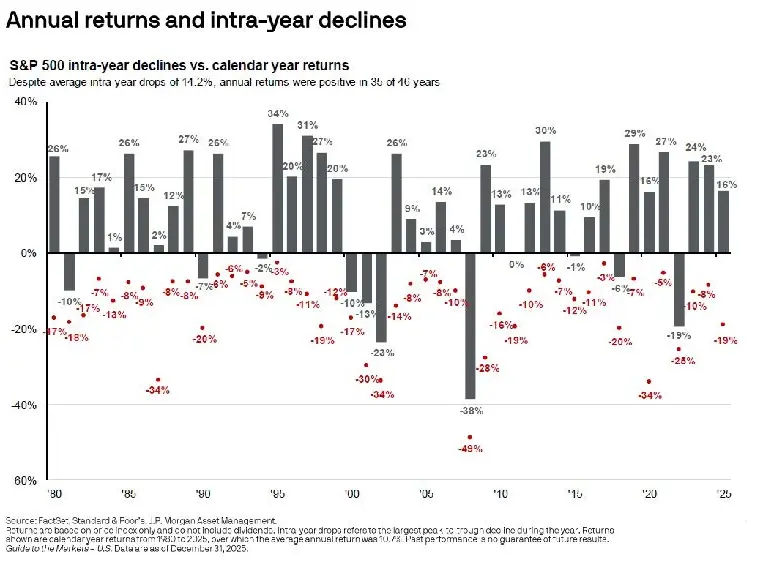
It is normal (maybe more normal than most clients expect) to have volatile and negative short term bouts, even in the long-term march higher for the stock market. Within any given year in the chart attached, the red markings/numbers indicate the lowest points reached within the year. Note that even while the year-end numbers (as in 2025) were positive most years, there are typically significant periods of loss.
This has been the case over much of Aurora’s 30 year investing history. Our focus on delivering returns that are ahead of inflation, providing growth in our clients’ investment portfolios, is augmented by our risk consciousness. The earnings progress of our invested companies yields the appreciation, and our valuation care tempers volatility and leads to outperformance when the market is weak. While certainly not perfect, and not a guarantee of any kind in the future – it is the intuitiveness of our investment discipline that gives us confidence in Aurora’s ability to deliver reward and progress over time.